



Series Overview
This annual series explores the interactions between trafficking victims and the legal system—starting with the criminal justice system—and delves into ongoing debates at the state and federal level about what reforms are needed to assist victims in escaping trafficking, in rebuilding their lives after they have escaped, and in preventing trafficking in the first instance.
Using force, fraud, and coercion, traffickers compel their victims to commit a range of illegal acts and then threaten to expose them to criminal prosecution. Victims are regularly arrested and prosecuted for a range of crimes resulting from their trafficking. Even years after they escape their traffickers, their criminal histories continue to haunt them, limiting access to employment, housing, education, and other areas of civic life.
2026 Human Trafficking Awareness Week:
February 16-20
*Registration is only required for Wednesday, February 18th
Sentencing Reform for Crime Victims: Does CT Need a Survivors Justice Act?
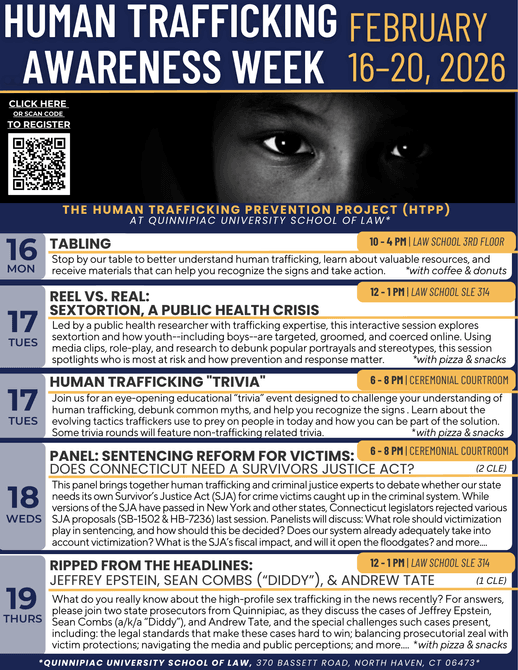
Wednesday, February 18, 2026, 6pm – 8pm (Attorneys admitted in Connecticut may claim up to two (2) CLE hours). Please join Quinnipiac Law’s Human Trafficking Prevention Project (HTPP)—along with the Connecticut Bar Association and the Connecticut Bar Foundation—for the only panel of Awareness Week 2026: “Sentencing Reform for Crime Victims: Does Connecticut Need a Survivors Justice Act?”
Using force, fraud, and coercion, traffickers control their victims, often requiring them to commit a range of illegal acts and then threatening to expose them to criminal prosecution. Victims are regularly prosecuted for a range of crimes resulting from their trafficking.
This panel brings together human trafficking and criminal justice experts to debate whether our state needs its own Survivors Justice Act (SJA or DVSJA or Domestic Violence Survivors Justice Act) for crime victims who have been arrested and prosecuted in the criminal system. While versions of the SJA have passed in New York and other states, Connecticut legislators rejected various SJA proposals (SB-1502 & HB-7236) last session. Panelists will discuss issues central to sentencing survivors in our state: What changes would the SJA enact in Connecticut? What role should victimization play in sentencing decisions? How should sentencing and re-sentencing requests from survivors be decided? Does our criminal system already adequately take into account victimization in its sentencing decisions? What are other potential impacts of survivor justice legislation?
This is a free event. Please submit anonymous questions for the panel here.
Speakers
-

CT Supreme Court Justice (ret.), Dept. of Children and Families Commissioner (ret.)




Resource Materials
-
Panelist State’s Attorney Jack Doyle testifies from about 1:36 - 2:42.
-
o Public Defenders Deborah Sullivan
o Chief State’s Attorney Patrick Griffin
o Our Panelist Kate Mogulescu
o Our Panelist Erin Williamson -
NY DVSJA LEGISLATION (2019)
-
Articles
• The primary victim in the Chicago case just published a book and has broken more than 20 years of media silence. Her name is Reshona Landfair, and her book is called, “Who’s Watching Shorty?”): https://www.rollingstone.com/music/music-features/r-kelly-reshona-landfair-jane-doe-tape-trial-interview-1235504614/.
• https://theexodusroad.com/human-trafficking-legal-system/
• https://humantraffickingsearch.org/debunking-the-fallacy-of-the-ideal-victim-articulating-the-mechanics-of-coercion/
• https://www.bu.edu/law/journals-archive/bulr/volume87n1/documents/SRIKANTIAHV.2.pdf
• https://www.wbasny.org/news/e-newletter/volume-13-number-01-fall-2024/the-ideal-victim-in-sex-trafficking-cases-and-the-international-communitys-contrasting-non-punishment-principle/
• https://www.law.georgetown.edu/gender-journal/online/volume-xxiii-online/prosecuting-sex-trafficking-how-the-indictment-of-ghislaine-maxwell-in-the-case-against-jeffery-epstein-highlights-the-difficulties-in-sex-trafficking-crimes-prosecution/
• https://www.americanimmigrationcouncil.org/blog/why-human-trafficking-cases-are-falling-through-the-cracks/ -
Documentaries
1) “Jeffrey Epstein: Filthy Rich”
2) “Surviving R Kelly” (on Tubi and Netflix)
Tuesday, February 17th, 2026
Speaker:
-

Master of Public Health Candidate, '26, Yale School of Public Health
Student Research Fellow, Solomon Center for Health Law & Policy at Yale Law School
Secretary-Designate, New Haven Youth Commission
Thursday, February 19th, 2026
Speakers:
PAST EVENTS
Risk and Resilience: Understanding Vulnerabilities and Pathways to Exploitation
February 20, 2025 (2 CT CLE Hours). Traffickers prey on vulnerabilities—whether it be race, immigration status, poverty, criminal involvement, lack of access to resources such as health care, or a combination of these. But preventing exploitation and trafficking is not just about recognizing risks; as a society, we must confront the root causes of vulnerability head-on by addressing systemic inequities, strengthening resilience, and creating a safer, more just world for all.
This event brought together experts in advocacy, research, and lived experience to unpack the deeper systemic issues that put people at risk for exploitation and trafficking. By adopting a holistic perspective, panelists explored how certain populations—such as people of color, men and boys, and undocumented individuals—face unique risks. Finally, by examining root causes, the conversation also identified practical solutions to address these vulnerabilities and better protect at-risk communities from all forms of exploitation.
Speakers
-
Executive Chair, Human Trafficking Prevention Project, Quinnipiac University School of Law, Third-year Law Student



Resource Materials
Protecting Immigrant Children: Their Journeys Before and After They Reach the U.S.
February 23, 2024 (2 CT CLE Hours). In recent years, the U.S. has seen an influx of unaccompanied children from Central America fleeing violence and extreme poverty in their home countries. For many Americans, it is difficult to understand what circumstances cause a child to leave their home and family behind to journey on their own to a foreign country. This panel sought to answer this and other questions by providing in-depth looks into the flight of these children away from their countries of origin and their journeys into the U.S.
The panel examined the cultural context and conditions of the three Northern Triangle countries—and Guatemala in particular—from which so many children flee. Panels also focused on migrant children’s journey to the U.S. and how they are processed and then resettled after they cross into the U.S. Finally, panelists came full circle by describing their struggles to regularize their immigration status in this country while providing insight on pathways for children to immigrate legally before they even leave home.
Panels featured attorneys and advocates who work with Central American migrant children and their families:
- Moderator: Tess Reagan, Senior Attorney, Kids in Need of Defense (KIND)
- Lesly Tayes, Staff Attorney, Kids in Need of Defense (KIND) International Program
- Emily Norman, Managing Director, Kids in Need of Defense (KIND)
- Aniosca Cortina, Unaccompanied Children Program, Connecticut Institute for Refugees and Immigrants (CIRI)
Resource Materials
GUATEMALA & NORTHERN TRIANGLE
THE U.S. BORDER
MIGRANT CHILDREN & TRAFFICKING IN THE U.S.
Broadening the Scope: A Conversation with Males Impacted by Sex Trafficking
February 22, 2024 (2 CT CLE Hours). While the anti-sex trafficking movement has brought awareness to female survivors of trafficking, the sex and labor trafficking of males is often overlooked. According to experts, the underreporting of men and boys is rampant. Stigma and shame, coupled with gender-specific awareness efforts, programs, and services that use non-inclusive language and imagery, deter males from disclosing grooming, sexual exploitation, and trauma in general.
This event featured a conversation with two experts drawing on their own lived experiences in order to illuminate some of the unique challenges faced by men and boys who have been sex and labor trafficked. Grounding the discussion in their lived experiences, both men highlighted topics such as prevalence; stereotypes and myths; vulnerabilities and intersectionality; “a day in the life;” why trafficked persons stay and how they get out; and solutions, including recovery, services, and reform.
The panel discussion was not recorded in order to retain anonymity. All attendees signed a confidentiality agreement, agreeing to not disclose any identifying information about the panelists, including their names and any other identifying details.
Speakers:
- Moderator: Sheila N. Hayre, Clinical Professor of Law, Quinnipiac University School of Law
- Nathan Earl, Public Health Consultant for Giantslayer, Executive M.P.H. at Yale University '24
- An anonymous male survivor of sex trafficking
Resource Materials
-
BOYS Documentary (pay to view on Vimeo)
Trauma-Informed Advocacy: Building Resilience for Clients and Service Providers
March 30, 2023 (2 CT CLE Hours). Today, anyone working with clients—including lawyers, paralegals, interpreters, social workers, and other service providers—should be trained in trauma-informed advocacy. Studies suggest that most adults in the U.S. have experienced a traumatic event at least once. Lawyers and other advocates who work with clients who have histories involving significant trauma—including trafficked persons, asylum seekers, domestic violence victims, unaccompanied minors arriving at our borders, etc.—struggle daily to balance the need to respond empathetically to clients’ experiences while avoiding vicarious trauma.
As part of the "Understanding Human Trafficking" series, the training took a deep dive into how individuals experience trauma and how advocates can use a trauma-informed approach when working with clients. Keighly Rector, Supervising Attorney of the Pro Bono Project Catholic Charities Community Services of the Archdiocese of New York, led the trainin: "Trauma-Informed Advocacy: Building Resilience For Clients and Service Providers."
Training provided an overview of trauma and the essential elements of trauma-informed care, including work-related stress stemming from exposure to trauma, such as burnout, secondary traumatic stress, and vicarious trauma. It also built on shared language around trauma and the physiology of traumatic responses to develop an understanding of how trauma manifests itself in legal cases, how attorneys and legal advocates can incorporate trauma-informed care into their practice, and why this leads to more effective advocacy.
Speakers:
- Keighly Rector, Esq., Catholic Charities Community Services, Archdiocese of New York (CCCS)
- Presenter: Sheila N. Hayre, Clinical Professor of Law, Quinnipiac University School of Law
Resource Materials
Children Crossing Borders: Migrant Children's Vulnerability to Trafficking
February 16, 2023 (2 CT CLE Hours). With images of the separation of migrant kids seemingly in our rearview mirror, many Americans are no longer focused on the children who continue to arrive at our border. We know little about who they are, why they come, what they encounter as they head north, how they are “processed” when they arrive, and the struggles they face as they are resettled in cities and towns across the United States.
To examine the trafficking risks faced by Central America migrants, this panel followed children on their journey to the U.S.—first, exploring the reasons why they leave their families and their homes and the dangers they face as they move north; next, focusing on their experiences at the border as the U.S. government attempts to process them in a child-appropriate manner; and, finally, highlighting their struggles to resettle here in Connecticut, adjust to American life, and regularize their immigration status in this country. The panel featured attorneys and scholars who have spent their careers working with Central American migrants.
Speakers:
- Presenter: Bharbara Viegas-Rocha, Human Trafficking Prevention Project Awareness Week Co-Chair, Quinnipiac University School of Law, J.D. Candidate 2024
- Presenter: Sheila N. Hayre, Clinical Professor of Law, Quinnipiac University School of Law
- Moderator: Danielle Robinson Briand, Founding Attorney at Justicia Law (Quinnipiac Law '12
- Autumn Quezada-Grant, Associate Professor of History, Roger Williams University
- Maegan Faitsch, Staff Attorney, Connecticut Legal Services
- Alisa Whitfield, Staff Attorney, Kids in Need of Defense (KIND)
- Attorney Alicia R. Kinsman, Law Office of Alicia R. Kinsman (formerly of Project Rescue, CIRI)
Sexual Assault on Campus & Title IX: Balancing the Interests of the Victim and the Accused
February 8, 2023 (2 CT CLE Hours). Passed in 1972, Title IX prohibits discrimination on the basis of sex in higher education; more specifically, Title IX protects students from sexual assault and sexual harassment. Over the past three presidential administrations (i.e. Obama, Trump, and Biden), Title IX regulations and enforcement have seesawed, and today Title IX has become the focus of fierce debates as to how to protect students from sexual violence while providing due process protections for those who have been accused.
To explore these debates, and to identify areas of possible consensus, three experts were invited—each working within the Title IX framework but from distinct vantage points—to share their perspectives and experiences. The panel explored the basics of how Title IX works: the actors, the process and procedures, and concepts like “affirmative consent” & “restorative justice.” Panelists were then asked to identify areas where the Title IX framework is working effectively and also to highlight areas ripe for reform.
Speakers:
- Presenter: Sheila N. Hayre, Clinical Professor of Law, Quinnipiac University School of Law
- Presenter: Olivia Hally, Human Trafficking Prevention Project Awareness Co-Chair, Quinnipiac University School ofLaw, J.D. Candidate 2023
- Moderator: Brittany Eckard, Training Co-Chair, Human Trafficking Prevention Project, Quinnipiac University School of Law, Former Dean of Students, Cogswell College
- Moderator: Emily Costanzo, Associate Attorney, Duffy Law
- Felice Duffy, Founding Partner, Duffy Law
- Elizabeth Conklin, Associate Vice President for Institutional Equity, Accessibility, and Belonging, and University Title IX Coordinator, Yale University
- Nicole Fournier Gelston, General Counsel, University of Connecticut
Resource Materials
Human Trafficking Prevention Project: Introduction to Human Trafficking Training
January 28, 2022. The Human Trafficking Prevention Project (HTPP) is a student-run organization at Quinnipiac University School of Law. The organization began in 2017 when a small group of students created an Introduction to Human Trafficking Training and presented it to hotels across the state of Connecticut. HTPP has since expanded its reach and now trains a variety of audiences including healthcare workers, lawyers, social workers, educators, and the general public. In addition to its training efforts, HTPP also collaborates with the Connecticut Bar Association, the Connecticut Bar Foundation, and leading anti-trafficking organizations to sponsor panels on topics relating to human trafficking and to advocate for survivor-friendly legislation.
HTPP's Introduction to Human Trafficking training seeks to educate audiences about various aspects of human trafficking, including how it is defined under state and federal law, who can be targeted, and how to identify human trafficking and report human trafficking.
Speakers:
- Kaylyn Fagan, Executive Chairwoman of the Human Trafficking Prevention Project, Quinnipiac University School of Law
- Londyn Zografakis, Vice-Executive Chairwoman of the Human Trafficking Prevention Project, Quinnipiac University School of Law
- Simran Thakur, Human Trafficking Prevention Project Member, Quinnipiac University School of Law
- Brittany Eckard, Human Trafficking Prevention Project Member, Quinnipiac University School of Law
Labor Trafficking at Home: Involuntary Domestic Servitude in the U.S.
January 26, 2022. When Americans think about human trafficking, we tend to focus on sex trafficking. And yet, experts estimate that labor trafficked persons (persons subject to forced labor) account for roughly two-thirds of all trafficked persons worldwide. Trafficking experts point to involuntary domestic servitude—which can affect live-in nannies, home health aides or personal care aides, maids, etc.—as the predominant form of labor trafficking in the U.S. and in Connecticut in particular.
Because it involves work in a private residence, involuntary domestic servitude can be especially difficulty to detect and thus presents unique vulnerabilities for victims. Domestic workers, especially women, face various forms of abuse, harassment, and exploitation, including sexual and gender-based violence. Victims are often underpaid—if they are paid at all—and many start their first day of work already facing enormous debt (known as debt bondage); others encounter employers who insist on confiscating their passports; and all find themselves isolated and often alone in the residences where they work, without freedom of movement or ability to leave their employment. Our patchwork of federal and state laws fails to protect most domestic workers, who do not receive basic protections extended to other workers—including a single day off per week.
To explore various dimensions of this pressing issue, this panel included four inspiring women with lived experience and/or legal expertise in connection with involuntary domestic servitude.
Speakers:
- Presenter: Sheila N. Hayre, Waring & Carmen Partridge Faculty Fellow, Visiting Associate Professor of Law, Quinnipiac University School of Law
- Presenter: Olivia Hally, Human Trafficking Prevention Project Awareness Co-Chair, Quinnipiac University School ofLaw, J.D. Candidate 2023
- Presenter: Kathleen S. Lima, Human Trafficking Prevention Project Co-Chair, Quinnipiac University School of Law J.D. Candidate 2022
- Moderator: Alicia Kinsman, Project Rescue, Connecticut Institute for Refugees and Immigrants (CIRI)
- Panelist: Evelyn Chumbow, Survivor Activist, Former Member, U.S. Advisory Council on Human Trafficking
- Agatha Schmaedick Tan, Labor Rights and Policy Attorney, SAFE Center for Human Trafficking Survivors
- Dati Katam Arma, Survivor of labor trafficking (involuntary domestic servitude)
Resource Materials
Finding Common Ground: Debates Around Sex Trade Reform, Decriminalizing Prostitution, and the Fight Against Trafficking
January 24, 2022. The Quinnipiac University School of Law Human Trafficking Prevention Project—along with the Connecticut Bar Association and Connecticut Bar Foundation—presented this first panel of Human Trafficking Awareness Week 2022: “Finding Common Ground: Debates Around Sex Trade Reform, Decriminalizing Prostitution, and the Fight Against Trafficking.”
Anti-human trafficking experts remain deeply divided on questions of legalizing or decriminalizing prostitution, sex trade reform, and how to draw the line between voluntary sex work, exploitation, and trafficking. There is general agreement among advocates that the criminalization of the sex trade—the current model in the United States—is not working. However, experts disagree over how best to reduce violence and other harms associated with the sex trade, while protecting trafficked persons and others trapped in the industry. Extrapolating from models in other countries—such as New Zealand, the Netherlands, and various Nordic countries—advocates can be theoretically divided into the following camps: legalization, full decriminalization, partial decriminalization, and outright criminalization.
To explore these debates, three experts on anti-trafficking and sex trade reforms were invited—first, to explain and dissect the four models; second, to explore their contrasting views based on their expertise as advocates working with trafficked individuals or individuals in the sex trade, as well as their own lived experiences; and, finally, to identify areas of common ground and opportunities for meaningful reform, both in our state and nationally.
Speakers:
- Presenter: Sheila N. Hayre, Waring & Carmen Partridge Faculty Fellow, Visiting Associate Professor of Law, Quinnipiac University School of Law
- Presenter: Olivia Hally, Human Trafficking Prevention Project Awareness Co-Chair, Quinnipiac University School ofLaw, J.D. Candidate 2023
- Presenter: Kathleen S. Lima, Human Trafficking Prevention Project Co-Chair, Quinnipiac University School of Law J.D. Candidate 2022
- Moderator: Erin Williamson, Vice President of Global Programs and Strategy, Love 146
- Speaker: Kate D'Adamo, Partner, Reframe Health and Justice
- Speaker: Mary Speta, Chief Impact Officer, Amirah, Inc.
Resource Materials
-
This Is What Will Make Sex Work in New York SaferCecilia Gentili, Oct. 17, 2021
-
New York Senate Bill, S64192019-2020 Legislative Session
-
"22 Years of End Demand: The Evidence is in"Kate D'Adamo, Oct 12, 2021
-
Policy 2021-08: Policy Regarding Sex WorkWashtenaw County Prosecutor's Office
-
Exited Prostitution Survivor Policy PlatformDecember 2018
Hidden in Plain Sight: The Faces of Labor Trafficking in Connecticut
September 24, 2021. The Connecticut Bar Foundation, Connecticut Bar Association’s Committee on Human Trafficking, and Quinnipiac’s Human Trafficking Prevention Project presented the fourth panel in the series, “Understanding Human Trafficking.”
When Americans think about human trafficking, they often focus on sex trafficking. And yet, experts estimate that victims of labor trafficking—i.e. forced labor—account for roughly two-thirds of all trafficking victims worldwide. Most Americans assume that labor trafficking happens mostly abroad, in Asia, Africa, or Latin America. For this and other related reasons, labor trafficking is woefully under-reported and under-prosecuted in the U.S., and around the world.
To explore what forms labor trafficking takes in Connecticut and the region, three legal advocates were invited, each with a unique perspective on labor trafficking and the people trapped by it. Drawing on their work with victims, and their expertise bringing legal cases on behalf of these individuals, panelists shed light on what labor trafficking looks like in Connecticut and surrounding states—from the migrant farmworkers who pick our crops, to the domestic workers who maintain our households, from the unaccompanied children crossing the border, to the immigrant spouses trapped in abusive marriages, and the workers who have helped build our nation. Panelists also discussed how our labor and immigration laws impact labor trafficking, and the fine line between labor exploitation and labor trafficking.
The panel featured experts who work with survivors of various forms of labor trafficking, including:
- Moderator: Sheila N. Hayre, Waring & Carmen Partridge Faculty Fellow, Visiting Associate Professor of Law, Quinnipiac University School of Law
- Presenter: Kathleen S. Lima, Human Trafficking Prevention Project, Co-Chair Quinnipiac University School of Law, J.D. Candidate 2022
- James Bhandary-Alexander, Yale Law School
- Alicia Kinsman, Project Rescue, Connecticut Institute for Refugees and Immigrants (CIRI)
- Daniel Werner, Radford & Keebaugh, LLC (formerly Southern Poverty Law Center)
The Movement to End Child Marriage: Where Does Connecticut Stand?
April 23, 2021. Anti-trafficking advocates include “forced marriage” as a form of human trafficking. The International Labour Organization estimates that over 15 million people worldwide find themselves in forced marriages. Child marriage—which overwhelmingly involves girls—is a subset of forced marriage associated with the greatest risk for abuse.
But to what extent is child marriage a problem in the U.S. and, more specifically, in Connecticut? Between 2000 and 2015, over 200,000 minors were married in the U.S. Starting in 2018, four states have enacted total bans on child marriage, notwithstanding opposition from those who have argued that such bans represent an unwarranted intrusion on the fundamental right to marry. In 2017, Connecticut enacted a partial ban, allowing minors between the ages of 16 and 18 to marry with judicial approval based on a petition by a parent or guardian. Proposals to enact a complete ban on child marriage in Connecticut have thus far failed.
Speakers:
- Moderator: Sharon Dornfeld, Adjunct Law Professor, Quinnipiac University School of Law, Legislative Affairs Committee, CBA Family Law Section
- Kate Ryan Brewer, Director and Writer, Knots: A Forced Marriage Story
- Fraidy Reiss, Founder and Executive Director, Unchained at Last
- Beverly Streit-Kefalas, Probate Court Administrator, Connecticut Probate Courts
- Nicholas Syrett, Historian and Author, American Child Bride: A History of Minors and Marriage in the United States
Resource Materials
-
"American Child Bride"preview of book by Nicholas Syrett
-
Connecticut Department of Health Child Marriage Statisticsprovided by Fraidy Reiss
-
TedxFoggyBottom: America's forced marriage problem by Fraidy Reiss
-
Knots: A Forced Marriage Story - Official TrailerKate Ryan Brewer, Director and Writer
-
TEDxOmaha: In Plain Sight: Forced and Child Marriage in Americaby Kate Ryan Brewer
-
"United States' Child Marriage Problem" Study FindingsApril 2021 - by Unchained at Last
-
The History of Minor Marriage Law in the US (and Connecticut)Nick Syrett, Department of Women, Gender, and Sexuality Studies, University of Kansas
Stories from the Underground: How Trafficking Survivors Experience the Criminal Justice System
February 19, 2021. The second panel in the series highlighted the stories of two trafficking survivors as they struggled to navigate the criminal justice system in their respective states. The panel explored the obstacles that trafficking victims face as they interact with the criminal justice system, moving from arrest to prosecution and conviction, and then to criminal record relief, including applications for pardons and vacatur.
Speakers:
- Moderator: Cynthia Lill, Third-year law student, Quinnipiac School of Law, Executive Chairwoman of the Human Trafficking Prevention Project
- Theresa Leonard Rozyn, The Underground Co-founder, Advocate, and Survivor Leader
- Sharifa Abdullah, Exploitation Intervention Project Advisory Board Member and Survivor
- Ann-Marie Boulay, Founder and CEO of The Underground
- Jillian Gilchrest, State Representative and Chair of Connecticut's Trafficking in Persons Council
- Leigh Latimer, Supervising Attorney with the Legal Aid Society in New York City
Fighting Human Trafficking by Decriminalizing Victims: Expanding Connecticut's Vacatur Laws
January 8, 2021. The inaugural panel began the series with a look at how expanding vacatur laws—allowing victims of human trafficking in Connecticut to apply to "vacate," or set-aside, their criminal convictions—can help to decriminalize trafficking survivors and enable them to re-join their communities as full members.
Speakers
-

Former CT Supreme Court Justice and former Commissioner of the CT Department of Children and Families






Resource Materials
-
“Compromise Vacatur Legislation” Analysis by QU Civil Justice Clinic, 01/2021
-
“Victims of Sex Trafficking Deserve Fairness in Preserving Dignity” Op-ed by Joette Katz, 12/29/2020
-
Connecticut Report Card Excerpt from full report included below
-
“Criminal Record Relief for Survivors of Human Trafficking in New York” Kate Mogulescu, 01/2020
