
CT Civil Legal Needs & Economic Impact Reports

Legal aid is an economic engine benefitting everyone in CT

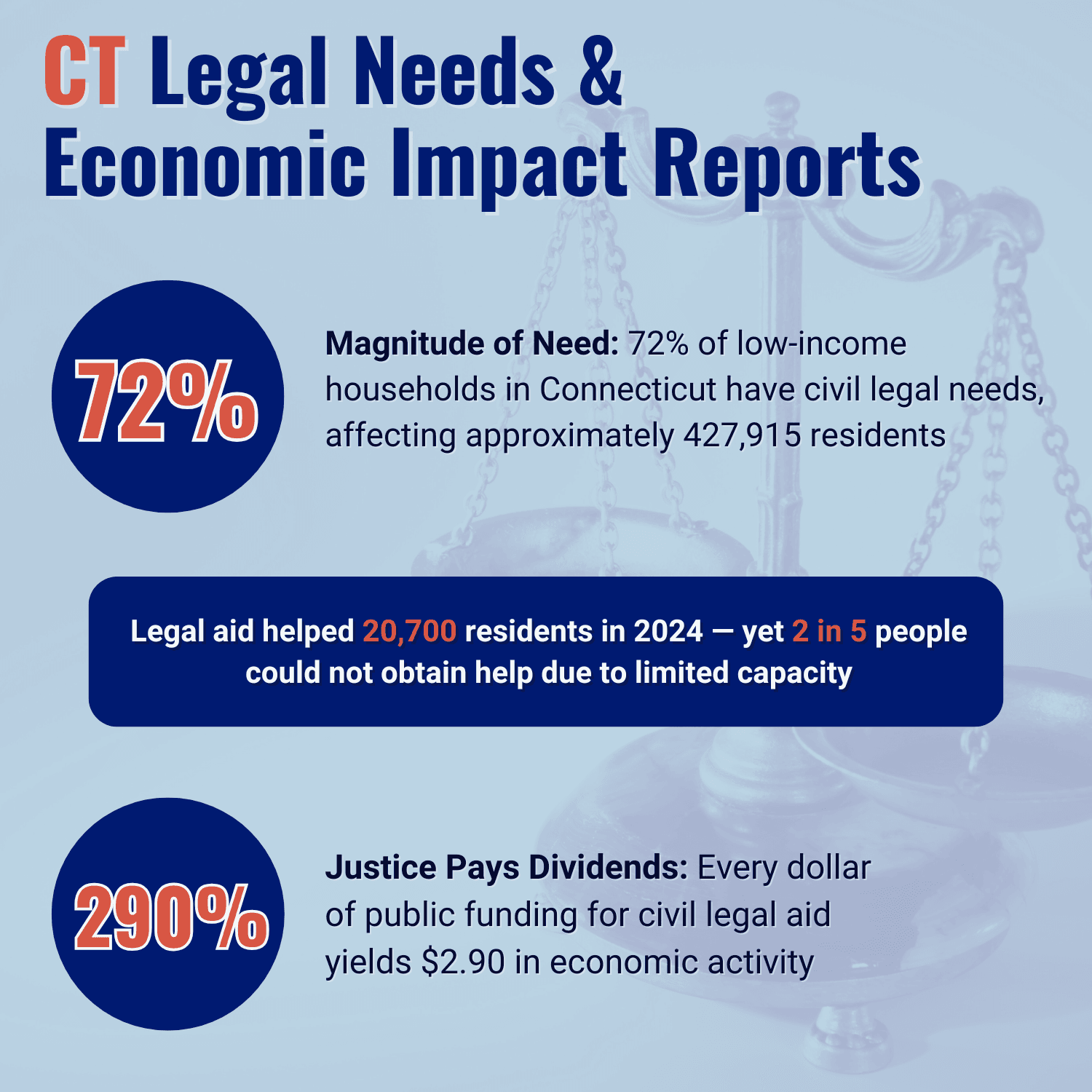
Image showing graphics of percentage of low-income CT residents in need of legal aid.

Connecticut Bar Foundation has commissioned two new reports that assess the state’s civil legal aid system and demonstrate the economic value of investing in legal services for low-income residents. 

Recommendations:

  1. Strengthen hotline capacity and coordination
  2. Increase resources for service delivery
  3. Advance salary parity, retention, and mentorship
  4. Expand service models (community justice and social workers)
  5. Support systemic reform and policy advocacy
  6. Modernize technology and information management
  7. Leverage technology and CTLawHelp.org to expand outreach
  8. Address geographic gaps through regional innovation
  9. Build capacity to serve a winder range of civil legal problems
  10. Expand housing crisis response
  11. Strengthen pro bono engagement

Download Reports
Civil Legal Needs Assessment, by CTData Collaborative (survey by University of New Hampshire Survey Center)

  • highlights the strengths of existing service providers  
  • identifies unmet needs 
  • offers recommendations to address system gaps
Economic Impact Report, by Downstream Strategies

  • quantifies direct financial benefits people receive when they can solve their legal problems 
  • calculates that legal aid services provided approximately $10 million in direct financial benefits to clients in 2024
  • shows that every dollar of public funding for legal aid generates approximately $2.90 in economic activity


2025 Profiles: Who does legal aid help?

  • Family
    Family

    Greater Hartford Legal Aid (GHLA) had a client who was the victim of serious domestic violence that resulted in a full no-contact criminal protective order. 

    The parties' minor child was then diagnosed with PTSD and did not wish to see the father. 

    Significant legal advocacy and negotiation resulted in court orders for sole legal custody for their client, child support, and primary residence for the client and child. Any access to the child by the father will be with thorough therapeutic protection and support.

  • Housing Rights
    Housing Rights

    The Center for Fair Housing Center negotiated with a property manager on behalf of a client who needed modifications for two children in wheelchairs. 

    The property manager agreed to repair sidewalks, add a ramp to the front door, and make repairs to the floor and an interior handrail.

  • Immigration Rights
    Immigration Rights

    "George" was brought to the U.S. by his parents when he was just a toddler. His mother died when he was young and George was abused by his father. 

    When he was a teenager, experiencing homelessness and struggling to find a way to survive after escaping his father's abusive home, he connected with the Center for Children's Advocacy (CCA)

    George helped identify a safe and nurturing adult he could live with and CCA successfully completed a Special Immigrant Juvenile Status petition to help George stay safely in the country, the only home he has ever known, with a safe family. 

    George now has a driver's license and a work permit, a job and healthcare. He gives back to the community, volunteering his time to help advocate for other immigrant children to find safety and permanency.

  • Individual Rights
    Individual Rights

    Connecticut Legal Rights Project (CLRP) extended advocacy on behalf of a limited English proficiency client, which included the filing of a formal grievance, advocacy at monthly treatment meetings and administrative meetings, and collaboration with the client's conservator to demand culturally competent treatment for the client. 

    A psychology student who speaks fluent Spanish was assigned to the client and agreed to meet with the client twice a week. The hospital renewed and updated the outside interpreting service contracts, which improved the reliability of interpreting services. 

    The client reports that hospital staff is no longer asking other patients to interpret for them. The client now has more access to active and effective treatment with Spanish interpreter services.

  • Veterans' Care
    Veterans' Care

    "Doug" had been living in a small studio apartment that he could afford on his VA Disability Income. 

    Staff from Connecticut Veterans Legal Center (CVLC) met him when his landlord was attempting to increase his rent by 33%—an increase that was unjustified and that he could not afford. 

    CVLC was able to negotiate a fairer rent and payment schedule as well as connect Doug with support to meet his payment obligations. With the help and accommodations, 

    Doug's housing is stable and he is no longer under the constant stress of housing debt.